
This page is based on the event record supplied by the Biolà team. Paper links point to the publisher or DOI record.
About this conversation
An ultrathin mesh interface grows with developing neural tissue, enabling long-term recording during brain development and regeneration.
We thank Dr. Hao Sheng for sharing the research, the thinking behind the discovery, and the challenges and decisions that shaped the work with the Biolà community.
PAPERS & REFERENCES
NatureEVENT MATERIALS
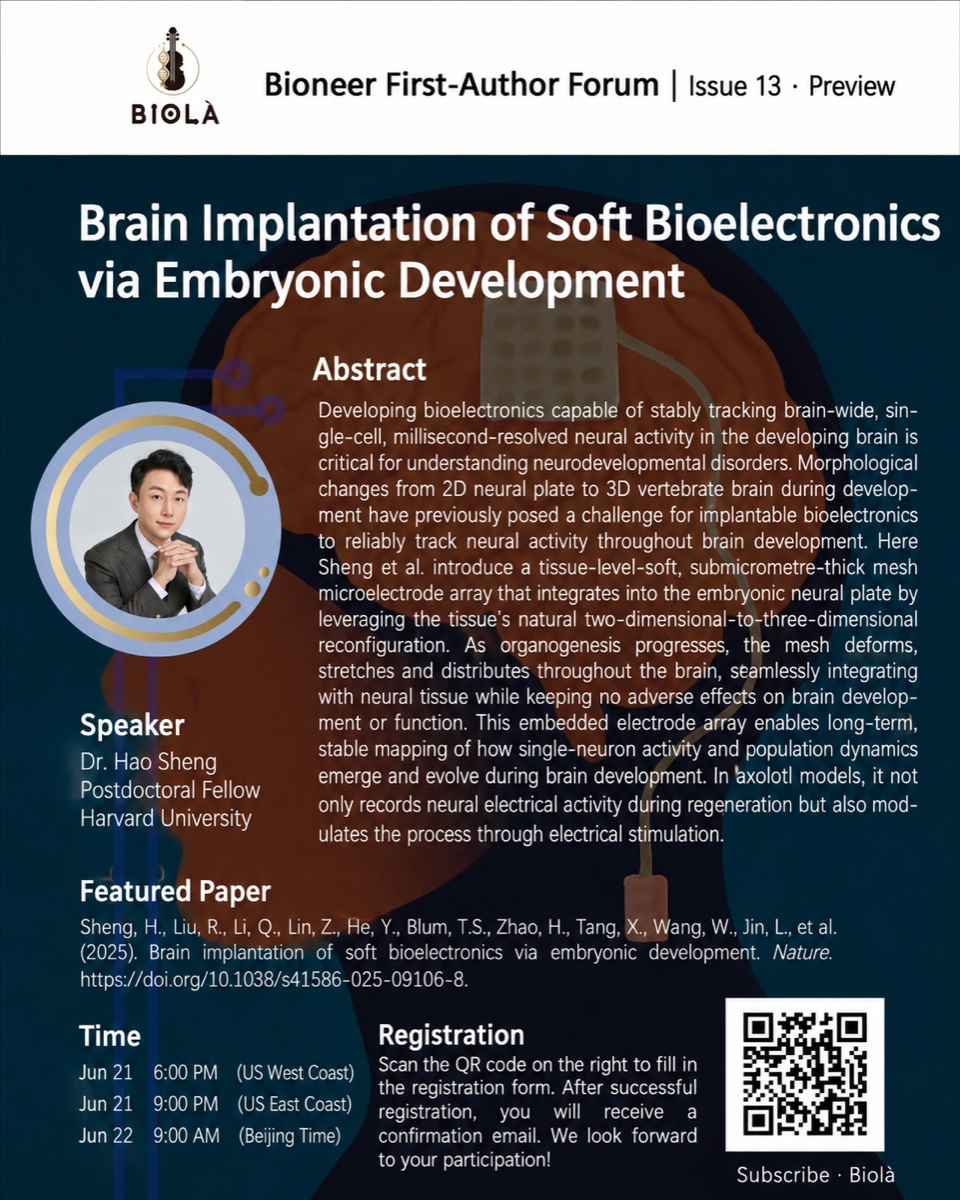
On June 22, 2025, at 9:00 AM Beijing Time, Biolà hosted the 13th issue of the Bioneer First-Author Forum, featuring Dr. Hao Sheng, a Postdoctoral Fellow in Bioengineering at the Harvard John A. Paulson School of Engineering and Applied Sciences. As the first author of the featured study, Dr. Sheng presented “Brain Implantation of Soft Bioelectronics via Embryonic Development,” published in Nature in 2025.
Monitoring neural activity continuously throughout brain development has remained challenging because the embryonic nervous system undergoes dramatic morphological transformation from a two-dimensional neural plate into a three-dimensional brain. Sheng and colleagues developed an ultrathin, tissue-level-soft mesh microelectrode array that is integrated into the embryonic neural plate and subsequently carried through this natural developmental process. As organogenesis proceeds, the mesh deforms and stretches with the tissue, becoming distributed throughout the developing brain while maintaining compatibility with normal brain development and function.
The embedded bioelectronic interface enables long-term and stable recording of neural activity with single-cell and millisecond-scale resolution, allowing researchers to follow how neuronal activity and population dynamics emerge during development. In axolotl models, the platform was also applied during brain regeneration, where it could both record neural electrical activity and influence regenerative processes through electrical stimulation. The work introduces a new strategy for integrating soft electronics with developing biological tissues by leveraging, rather than resisting, the tissue’s own morphogenesis.
We sincerely thank Dr. Hao Sheng for sharing the scientific motivation, engineering design, and biological applications behind this work with the Biolà community, and for discussing how soft bioelectronics can open new possibilities for studying neural development and regeneration.
Citation: Sheng, H., Liu, R., Li, Q., Lin, Z., He, Y., Blum, T. S., Zhao, H., Tang, X., Wang, W., Jin, L., Wang, Z., Hsiao, E., Le Floch, P., Shen, H., Lee, A. J., Jonas-Closs, R. A., Briggs, J., Liu, S., Solomon, D., … Liu, J. (2025). Brain implantation of soft bioelectronics via embryonic development. Nature, 1–11. https://doi.org/10.1038/s41586-025-09106-8