This page is based on the event record supplied by the Biolà team. Paper links point to the publisher or DOI record.
About this conversation
A rescue-like behavior in mice reveals a direct tongue-to-brain pathway that can rapidly promote arousal from anesthesia.
We thank Dr. Peng Cao for sharing the research, the thinking behind the discovery, and the challenges and decisions that shaped the work with the Biolà community.
PAPERS & REFERENCES
Science AdvancesEVENT MATERIALS
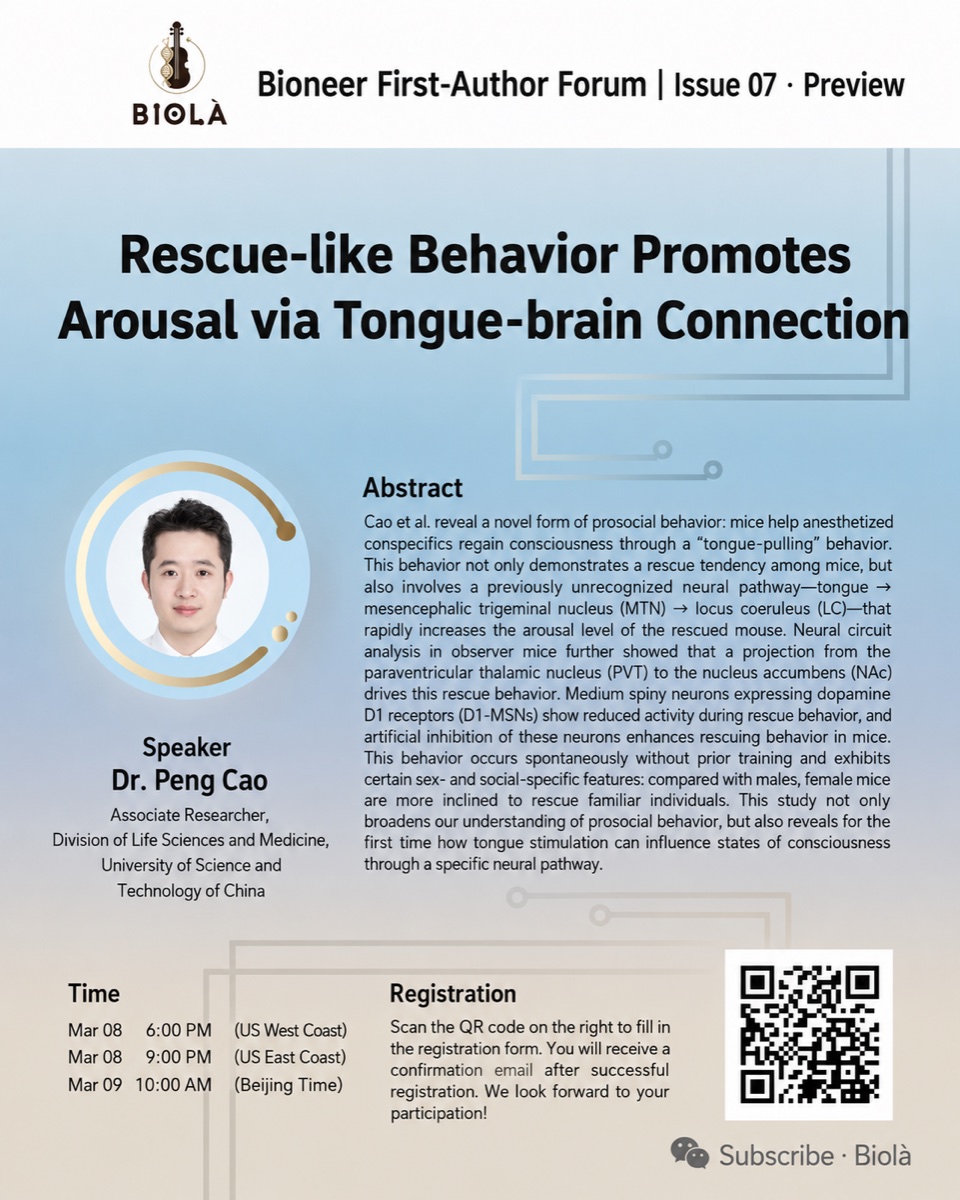
On March 9, 2025, at 10:00 AM Beijing Time, Biolà hosted the 7th issue of the Bioneer First-Author Forum, featuring Dr. Peng Cao, Associate Researcher in the Division of Life Sciences and Medicine at the University of Science and Technology of China (USTC). As the first author of the featured study, Dr. Cao presented “Rescue-like Behavior Promotes Arousal via Tongue–Brain Connection,” based on work published in Science Advances in 2025.
The study uncovered a striking form of prosocial behavior in mice: bystander mice spontaneously attempted to help anesthetized conspecifics recover, including through a distinctive tongue-pulling behavior. Cao and colleagues identified a previously unrecognized tongue → mesencephalic trigeminal nucleus (MTN) → locus coeruleus (LC) pathway through which this physical interaction rapidly promoted arousal in the anesthetized animal.
The study further examined the neural mechanisms driving rescue-like behavior in the bystander. A projection from the paraventricular thalamus (PVT) to the nucleus accumbens shell (NAc) contributed to the behavior, while dopamine D1 receptor-expressing medium spiny neurons (D1-MSNs) showed reduced activity during rescue and their experimental inhibition enhanced helping behavior. The behavior emerged without prior training and also exhibited sex- and social-context dependence, with female mice showing a stronger tendency to assist familiar individuals. Together, the findings connect prosocial behavior with a previously unknown sensory pathway capable of modulating arousal and consciousness-related brain states.
We sincerely thank Dr. Peng Cao for sharing the discoveries and scientific story behind this work with the Biolà community, and for discussing how social behavior, sensory input, and arousal can interact through defined neural circuits.
Citation: Cao, P., Liu, Y., Ni, Z., Zhang, M., Wei, H.-R., Liu, A., Guo, J.-R., Yang, Y., Xu, Z., Guo, Y., Zhang, Z., Tao, W., & Wang, L. (2025). Rescue-like behavior in a bystander mouse toward anesthetized conspecifics promotes arousal via a tongue-brain connection. Science Advances, 11(4), eadq3874. https://doi.org/10.1126/sciadv.adq3874