
This page is based on the event record supplied by the Biolà team. Paper links point to the publisher or DOI record.
About this conversation
A surrogate-brain framework uses virtual perturbations to infer directed effective connectivity from large-scale neural data.
We thank Zixiang Luo for sharing the research, the thinking behind the discovery, and the challenges and decisions that shaped the work with the Biolà community.
PAPERS & REFERENCES
Nature MethodsEVENT MATERIALS
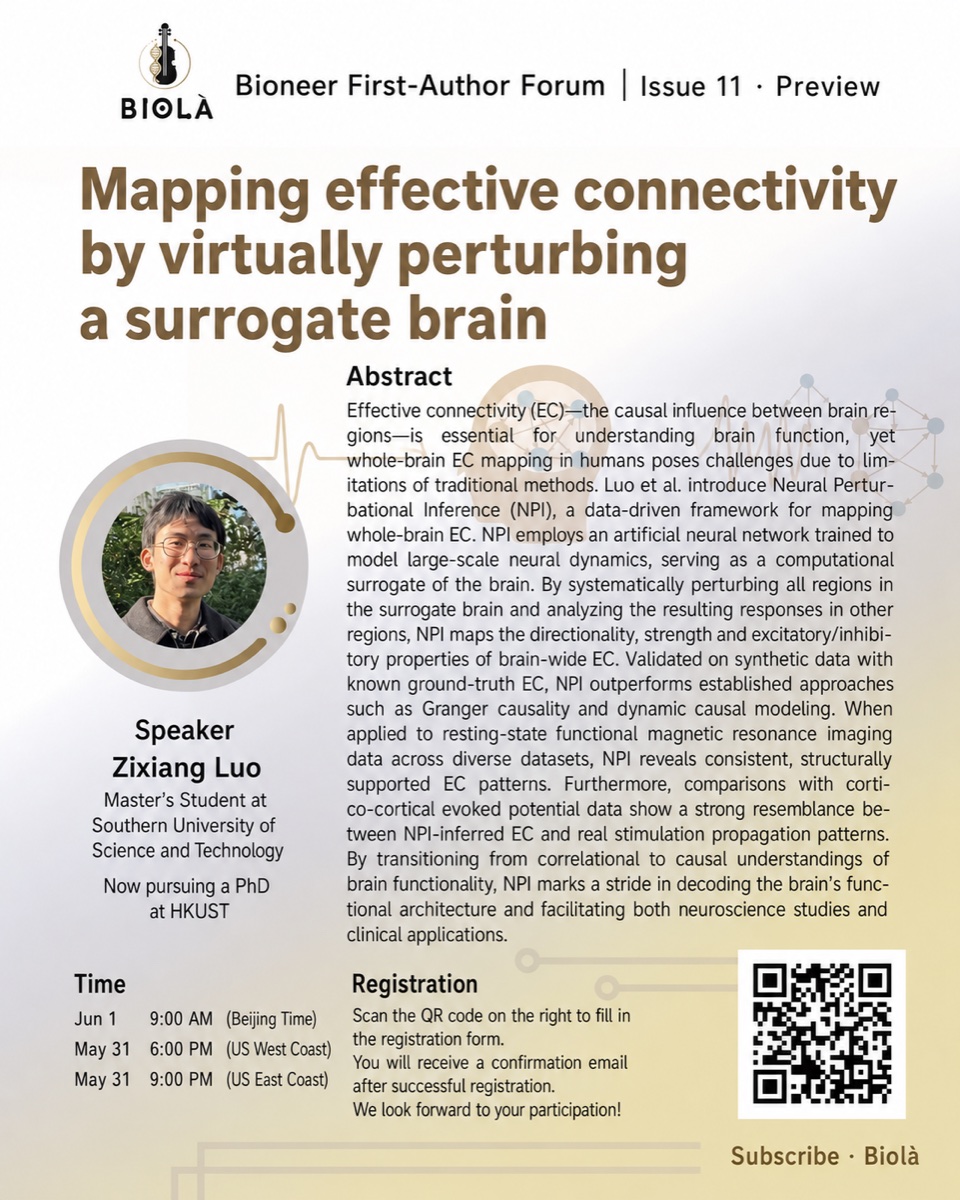
On June 1, 2025, at 9:00 AM Beijing Time, Biolà hosted the 11th issue of the Bioneer First-Author Forum, featuring Zixiang Luo, a PhD student at the Hong Kong University of Science and Technology (HKUST) who previously completed his master’s training at the Southern University of Science and Technology (SUSTech) in the group of Professor Quanying Liu. As the first author of the featured study, Luo presented “Mapping Effective Connectivity by Virtually Perturbing a Surrogate Brain,” published in Nature Methods in 2025.
Effective connectivity describes the directional and potentially causal influence of one brain region on another, yet mapping such relationships across the whole human brain remains technically challenging. Luo and colleagues developed Neural Perturbational Inference (NPI), a data-driven framework in which an artificial neural network is first trained to reproduce large-scale brain dynamics and thereby serves as a computational surrogate of the brain. By virtually perturbing individual regions of this surrogate system and examining the resulting activity changes elsewhere, NPI estimates the direction, strength, and excitatory or inhibitory properties of brain-wide effective connectivity.
The method was validated using synthetic datasets with known ground-truth connectivity, where it outperformed established approaches including Granger causality and dynamic causal modeling. Applied to resting-state fMRI datasets, NPI revealed reproducible effective-connectivity patterns that were supported by structural connectivity, while comparisons with cortico-cortical evoked-potential data showed strong correspondence between NPI-inferred interactions and experimentally observed stimulation propagation. The work provides a computational route from correlational descriptions of brain activity toward more causal models of large-scale functional organization.
We sincerely thank Zixiang Luo for sharing the development and scientific motivation behind NPI with the Biolà community, and for discussing how computational surrogate models and virtual perturbation can contribute to mapping causal interactions across the human brain.
Citation: Luo, Z., Peng, K., Liang, Z., Cai, S., Xu, C., Li, D., Hu, Y., Zhou, C., & Liu, Q. (2025). Mapping effective connectivity by virtually perturbing a surrogate brain. Nature Methods. https://doi.org/10.1038/s41592-025-02654-x