
This page is based on the event record supplied by the Biolà team. Paper links point to the publisher or DOI record.
About this conversation
An integrated look at microglial immune modulation, engineered astrocyte therapy, and protective APOE biology as complementary strategies for Alzheimer’s disease.
We thank Dr. Yun Chen for sharing the research, the thinking behind the discovery, and the challenges and decisions that shaped the work with the Biolà community.
EVENT MATERIALS
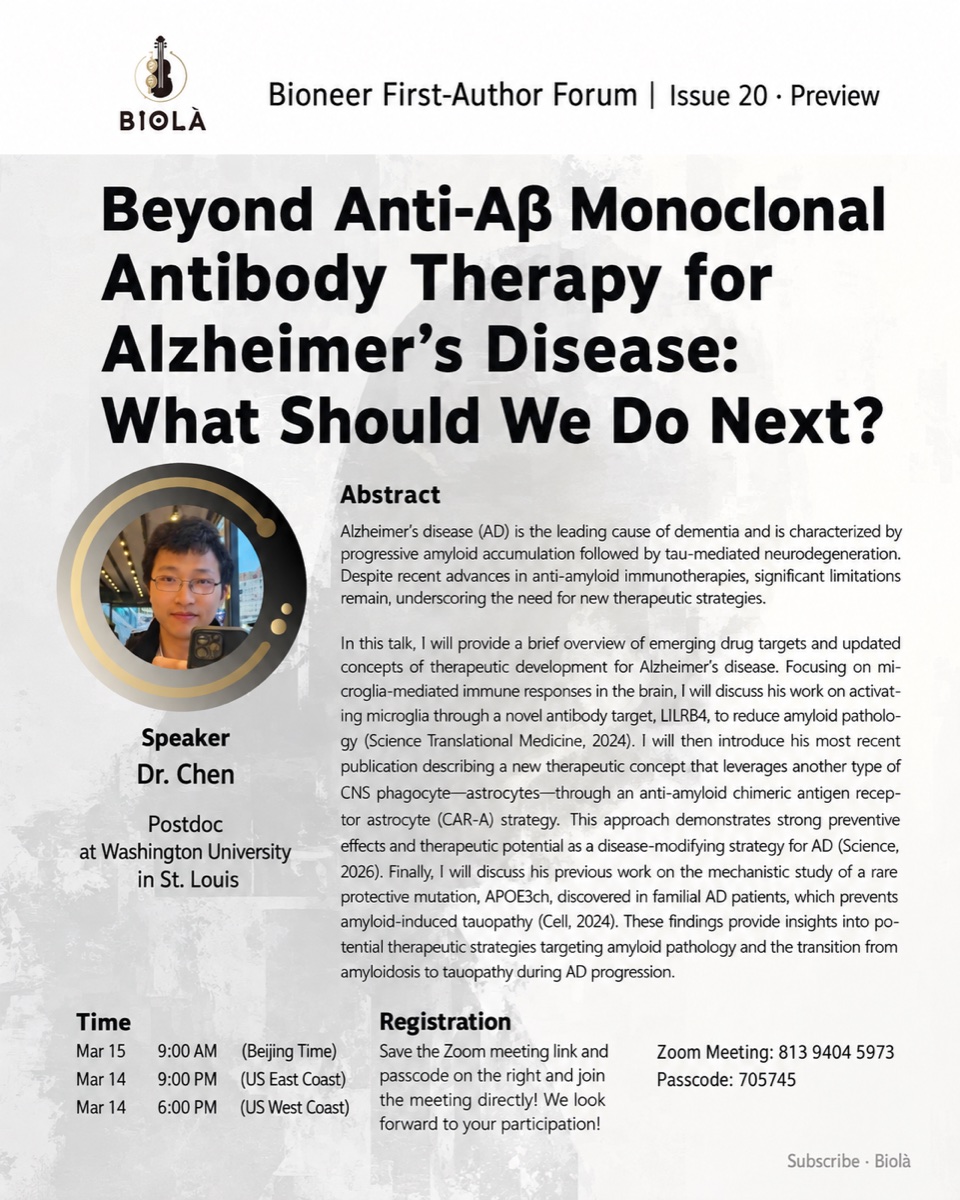
On March 15, 2026, from 9:00 to 10:30 AM Beijing Time, Biolà hosted the twentieth issue of the Bioneer First-Author Forum, featuring Dr. Yun Chen, a postdoctoral researcher at Washington University in St. Louis. The session was delivered in Chinese. Under the title “Beyond Anti-Aβ Monoclonal Antibody Therapy for Alzheimer’s Disease: What Should We Do Next?”, Dr. Chen drew on several of his own studies to discuss emerging therapeutic strategies that move beyond conventional anti-amyloid monoclonal antibody approaches.
Alzheimer’s disease is characterized by progressive amyloid-β accumulation followed by tau-mediated neurodegeneration. Although anti-amyloid immunotherapies have brought important advances, their limited efficacy and safety concerns highlight the need for additional disease-modifying strategies. Dr. Chen first discussed work targeting the microglial receptor LILRB4, in which antibody-mediated modulation of microglia reduced amyloid pathology in a mouse model, illustrating how innate immune pathways may provide alternative therapeutic entry points.
He then introduced a different strategy that harnesses another major phagocytic cell population in the central nervous system: astrocytes. By engineering amyloid-targeting chimeric antigen receptor astrocytes (CAR-A), Chen and colleagues developed a cell-based approach that showed strong preventive effects against amyloid pathology in experimental models. This work proposes a new therapeutic concept in which endogenous glial functions can be redirected toward the clearance of pathological proteins.
The talk also revisited Chen’s earlier work on the rare protective APOE3 Christchurch (APOE3ch) variant. Mechanistic studies showed that this variant can alter microglial responses and suppress the progression from amyloid pathology to tau seeding and spread, providing clues to how naturally occurring protection against Alzheimer’s disease might be translated into therapeutic strategies. Together, these studies span microglial immune modulation, engineered astrocyte therapy, and protective APOE biology, offering complementary approaches to intervening in both amyloid pathology and the downstream transition toward tau-mediated neurodegeneration.
We sincerely thank Dr. Yun Chen for sharing this integrated perspective with the Biolà community and for discussing how insights from innate immunity, glial biology, genetic protection, and cell engineering may inform the next generation of Alzheimer’s disease therapies.
Citations:
Hou, J., Chen, Y., Cai, Z., et al. (2024). Antibody-mediated targeting of human microglial leukocyte Ig-like receptor B4 attenuates amyloid pathology in a mouse model. Science Translational Medicine, 16(741), eadj9052. https://doi.org/10.1126/scitranslmed.adj9052
Chen, Y., Song, S., Parhizkar, S., et al. (2024). APOE3ch alters microglial response and suppresses Aβ-induced tau seeding and spread. Cell, 187(2), 428–445.e20. https://doi.org/10.1016/j.cell.2023.11.029
Chen, Y., & Holtzman, D. M. (2024). New insights into innate immunity in Alzheimer's disease: from APOE protective variants to therapies. Trends in Immunology, 45(10), 768–782. https://doi.org/10.1016/j.it.2024.08.001
Chen, Y., Liu, Y., Nguyen, K., et al. (2026). Targeting amyloid-β pathology by chimeric antigen receptor astrocyte (CAR-A) therapy. Science, 391(6789), eads3972. https://doi.org/10.1126/science.ads3972